Indianapolis Motor Speedway
How, and where, did the iconic Indianapolis Motor Speedway really come to life in the collective imagination of racing enthusiasts?
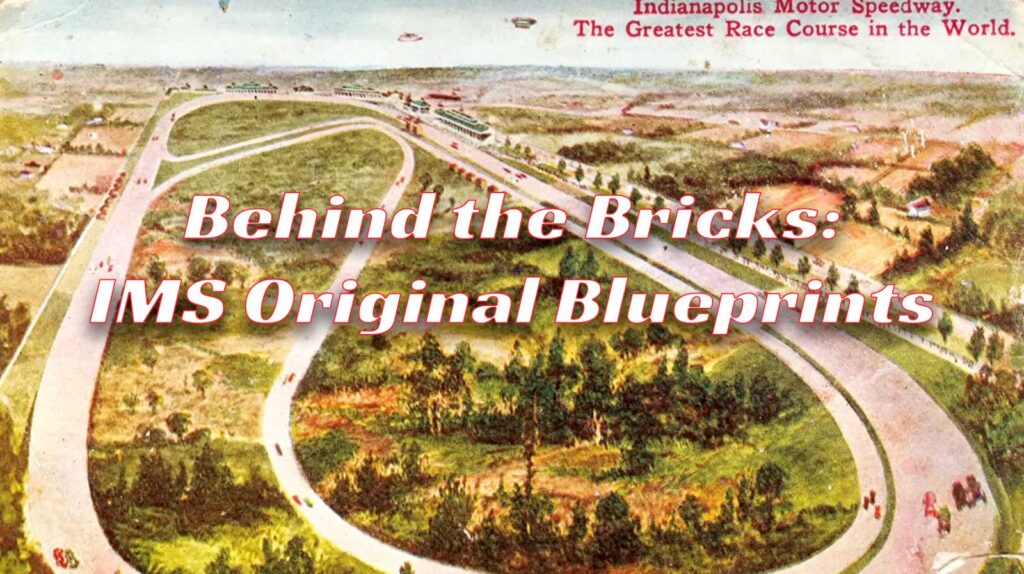
What if, in an alternate reality, it wasn’t a 2.5-mile oval track but something entirely different? This intriguing episode of Behind the Bricks delves deep into these questions, uncovering a wealth of history and storytelling that reveals not only the origins of the great IMS but also the pivotal moments that shaped it into what it is today. We will explore the various places where the legendary story of IMS began, as well as the fascinating discovery of a remarkable 117-year-old blueprint depicting a 5-mile racetrack that almost became the famed track we know and love today.
As part of our ongoing series to share all that is awesome about the Indianapolis Motor Speedway, we’re sharing a bit of the track’s backstory. The video tells the story beautifully. Scroll below for the video transcript.
Indianapolis Motor Speedway fans, Doug Bowles here with you for another episode and another season of Behind the Bricks.
Welcome aboard! I can’t wait to do some of these. Michael Kaltenmark will also join me again this year to tell the stories that make the Indianapolis Motor Speedway so special. Speaking of special, we’re going to start today talking about why the Indianapolis Motor Speedway is where it is, right behind us here at 16th and Around About, or 16th and Georgetown.
We’re standing on a spot today that in 1908 Carl Fisher came out here with Lynn Trotter, a man who was helping him find some real estate to find these 320 acres that became the Indianapolis Motor Speedway. They drove out here five and a half miles and decided this would be the site for the Speedway. Gate One, Lynn Trotter said, “Carl, Gate One could be right there. The trains dropped people right in front of Gate One.
If you come to the Speedway today, you can still see the remnants of where that railroad line was as it headed out towards Crawfordsville, Indiana. It still goes along Crawford Road, so this was the beginning in 1908, when Carl Fisher, Lynn Trotter, and partners decided it was time to build the Indianapolis Motor Speedway, and on March 20, 1909, incorporated it. You know what happened after that. Right now I’m just outside Turn Two. A lot of cool things have happened here, and it used to be a hotel where I’m standing right now. Actually, the Mouse House was here as well. All kinds of things have been here at the Indianapolis Motor Speedway. But in March of 1909, this famous photo was taken somewhere really close to this location.
This is Louis Strang, one of today’s race car drivers. In fact, the 1911 pole sitter for the Indianapolis 500, Carl Fisher, had him come out.
Take a look at this: how the track was going to be laid out here. It’s on the southwest side, behind what is now Turn Two. Behind us, or behind the camera, as you look, was 16th Street now, but it was called Crawfordsville Pike back in the day, just a dirt road. That’s why we built the Indianapolis Motor Speedway to give those manufacturers a place to test that was paved, but this is where that famous photo we think took place over 117 years ago, right here outside of the golf course, outside of Turn Two at the Indianapolis Motor Speedway.
So now I’m standing right in between the golf course and the back stretch here at the Indianapolis Motor Speedway, just a little bit north of Turn Two, right on what we call Shaw Drive, named after Wilbur Shaw.
Still, many people don’t realize we’re famous for the oval. Still, when Carl Fisher had envisioned the Indianapolis Motor Speedway, or a racetrack, when he was trying to figure out where to go, he believed that a large oval, at least three miles long, was really what you needed to test cars of the day; he looked everywhere. The 320 acres here at the Speedway, he felt, would fit that three miles.
P.T. Andrews, who was hired to be the superintendent to help build the racetrack, came and looked at the land and said to Mr. Fisher, “We need to make the track just a little bit smaller, so that we can put grandstands around the outside instead of having the track around the outside. So that’s how we ended up with a two-and-a-half-mile oval, but Carl Fischer always thought there would be a five-mile road course as part of this racetrack, and this Shaw Drive here.
Oftentimes, people think maybe it was put here because this was the beginning of what would have been a road course. Now, we all know that the Indianapolis Motor Speedway built a road course to host Formula One in 2000, and today we host the Sanfiro Grand Prix here as we head into May. So, our road course is used, and that vision came about 100 years later.
The other thing that happened here: hangars. This was an airport at the Indianapolis Motor Speedway for balloons early on, and later for aviation. The first aviation meet was in 1910 here at the Indianapolis Motor Speedway. And then, during World War One, we were at the Aviation Depot. Planes flew in, got fixed at the hangars here, and then went back out to the field to train our pilots for World War One — lots and lots of history right here between turn two and turn three at the back stretch of the Indianapolis Motor Speedway.
So we’re in a place that not a lot of people go to at the Indianapolis Motor Speedway, in the basement of the Admin Building. This is where we store a lot of the drawings, the things that aren’t digital anymore, all the things that when the Speedway first started being constructed, even up till recently, they all came in these architectural drawings. I was in here in 2020 going through things, and actually found that really cool blueprint of the Indianapolis Motor Speedway when it was first built.
Many of you have the T-shirt, but today we thought we’d come back down here and really tie together Carl Fisher, the road course, and what he wanted to do. One of these doors is titled “History Miscellaneous Old Drawings”. We thought we’d open it up and see what we might find, but we just opened it a second ago and haven’t started going through it, so we’re doing this together.
So that old golf course right here, looking at some of the old grandstands, maybe from some point in time. Here’s something from 1935. Here’s something from November 21, 1910. Gives you an idea of the racetrack, the layout of what it looked like back then. This was actually designed by some architects back then. Actually, it’s from 1909.
Oh, here we go, ladies and gentlemen. This would be planned for a raceway. There you go, Carl Fisher’s vision of a road course in blueprint form inside of his oval. Don’t see a date on this, but there you go. That would have been his vision.
Obviously, the road course is a little different today, but for those folks that know us as an oval track, that’s what we’re known for. There was a vision 117 years ago that there would be a road course inside, and one of the fun things is that it’s right here in the basement of the Indianapolis Motor Speedway.
It’s amazing how the Indianapolis Motor Speedway continues to tell stories 117 years after Carl Fisher and Lynn Proddax sat on the corner outside this building and envisioned it.
Thanks for joining us on this ride, as we showed you some of the places around the Speedway. There’s a lot more to come behind the bricks. Continue to watch us. Who knows, we may tell the story of a bowling alley across the Street, a racetrack, and even a zoo that we’re on the south side of 16th Street someday, behind the bricks.

The Wings and Wheels Foundation team headquarters is hosted at the Indianapolis Motor Speedway Turn 2 VIP Suites. Join us to watch racing in real time.
Header graphic video screenshot © 2026 Indianapolis Motor Speedway. Used for editorial.